|
|
|


ADR and the Talmud© 2007
by Jay H Isenberg AIA
(article continued)
...Growing up non-orthodox, I never formally studied the Talmud, but have learned throughout my adult
life as an architect, mediator and arbitrator to appreciate and embrace the “to and fro” of the Talmudic method. I believe that
navigating the Talmud’s intellectual and spiritual intricacies is in many ways similar to an ADR neutral’s search for truth and
fairness in the dispute resolution processes, especially in mediation. As such I feel a deep affinity with this tradition and
carry it with me into each session I serve on as an ADR neutral. The vigorous and emotional exchanges between parties,
the reliance on the documents and exhibits as “shared text”, the conversation as it moves back and forth through the difficult
stages of resolution or dissolution all reflect the intensity of the study of the Talmud. The task of the neutral, as it is with
the scholar, is to be an interpreter and filter for the story unfolding, and through this process serve as a conduit and catalyst
for the emergence of a greater understanding among the participants. In such a capacity the neutral and the scholar participate
in a “conversation” greater than themselves, beyond the limitations established by contract terms, legal constructs and the issues
of the conflict itself.
The Beauty of the Page
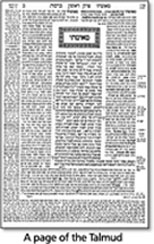
The Talmud is a visually rich and metaphorical delight. A typical page is shown above in the illustration. Central to each page
you see the text of the ancient oral law surrounded by subsequent explanation, discussion, interpretation, and commentary by
various rabbis and scholars throughout the ages. One can see from this beautiful layout not only the graphic presentation but
also the “roadmap” of this Talmudic search for understanding, wisdom and the “kernel of truth” that may hide within this structure.
The subject of this vigorous debate can range from the rules of everyday Jewish life and ritual to deep ethical and legal
conundrums of jurisprudence. The traditional picture of Talmudic study is one of student pairs engaged in heated discussion
and argument over each word, searching within a labyrinth along a Mobius strip. The image is delightful. Can you see the analogy
of the Talmud’s guiding organization and methodology to that of the voluminous exhibits of tabbed three ring binders presented
before an arbitrator on a complex construction case? Add to this the note taking, underlining and feverish search through tabs
to keep up with the presentation of the case, and you begin to feel the rhythm of the Talmudic method.
The “Balance of Imbalance”
In reading the text, “The Talmud and the Internet, A Journey between Worlds” by Jonathan Rosen, I was struck by several
statements he writes that make evident stunning parallels between the Talmudic method and the web-like digital world of
the internet. If you add to this pair the multifaceted condition of the ADR neutral engaged in a difficult arbitration or
mediation, the picture he paints is succinct;
“…the Talmud, so clearly crafted by querulous men in a constant state of disagreement and argument, poring over the
mundane details of contemporary life and then taking flight in wild inventive riffs….” (p. 86)
What neutral can’t relate listening to the fanciful machinations of an advocate building their client’s case? How
often has a neutral had to endure the repetitive mantra of a single incident told multiple times which one party
feels so strongly proves their point while the other dismisses it as irrelevant or trivial? Yet, this is the heart
of the Talmudic method according to Rosen, this side by side, point counterpoint culture so revered by scholars so
rich in learning and the “balance of imbalance”. If you are one that seeks absolute truth and are uncomfortable
with ambiguity and contradiction then Talmud will drive you crazy, and ADR will do the same. To be a construction
arbitrator or mediator is to dwell at the intersection of architecture, law, ethics, psychology, autobiography and
theater with the ever present boiling of human emotions lying under the surface waiting for the moment the plug might blow.
As such you are in the midst of the Talmudic dialectic,
“…inside the tangle of…conflicting lives and truths…a gathering of profound contradictions…making room for all the
contradictory elements.” (Rosen p.62-64)
Neutrals uncomfortable with this uncertainty, mutually exclusive facts and partial truths will not last long in the
ADR business nor with the study of Talmud or other disciplines that search for truth but embrace its ultimate
inconclusiveness. You either take joy in this condition or find another line of work-- and maybe religion too!
Why Do We Do This?
Every ADR neutral has their reasons for practicing this judicial art form. Some might enjoy the power and authority
that comes with the territory, others the deference shown them by the skillful, sometimes brilliant, attorneys plying
their trade, and others who feel significant, possibly omnipotent while conducting a proceeding. Some, and maybe the
best relish in profound humility the trust given them to find fairness and justice in their cause and to end a generally
unpleasant and unprofitable episode in the personal and professional lives of those before them.
I, for one, take comfort in ambiguity and contradiction, in the ”the allure of wise skepticism,” as Ruth Calderon says
in her essay “We Enter the Talmud Barefoot”. She describes the Talmudic “text” as sacred in the religious sense, but argues
that it should be regarded as raw material for individual creation and interpretation similar, “…in the way the artist
attribute power to their paints, or poets to their words…”
……...”Ambivalence and opposition to the text are an integral part of the study experience… Interpretive skills,
hermeneutics, criticism, and empathy serve the study…well.
http://www.culturaljudaism.org/ccj/articles/26, “WE ENTER THE TALMUD BAREFOOT”, Ruth Calderon The Center for Cultural Judaism)
Here the analogy resonates between the various methods a neutral has to call upon and the study of the text and commentaries
of the Talmud. The richness of the experience stems from the tradition of this interaction of text, law and human behavior.
Applying individual interpretations to the documents and contracts submitted, the laws cited, and the differing personal
narratives of the case unfolding before a neutral is the essence of the ADR process. The responsibility of the neutral is to
envelop oneself in the material like the Talmudic scholar. Anything less would be a disservice to the disputing parties.
Who Owns the Process?
The question I pose here by illuminating parallels between the Talmudic method and the ADR process is to challenge the “orthodoxy”
of attorneys’ control over the current state of ADR in construction. I wish to lobby for opening the door to others who may be
equally suited through professional experience and interpretive skills to help prevent and resolve design and construction disputes.
In this same article Calderon challenges the grip the Orthodox has on entry to the study of Talmud and argues forcefully for
opening those doors to other scholars especially women for the contributions they can make.
”Yet the challenge in this rich reservoir remains as vital as ever, continually attracting a new circle of people to join
the community of Torah scholars, irrespective of the views or opinions of the "veterans….The revolution happens when new minds,
free of conventional, established ideological commitments, delve and blend and create within the greatest Jewish textual
treasure of all time, to produce a creation that is simultaneously subversive and peace inspiring” (Calderon)
In a similar way I ask the question, “Is the current state and future of ADR in construction too important to leave entirely in
the hands of the “veterans”? A provocative question, yes. The parallels between the secular entering the study of Talmud and
the non-attorney neutral entering the ADR venue, when narrowly defined as “legal”, are revealing. In my experience most
construction disputes do not involve complex legal issues, rather a breakdown in communication, a loss of trust, a challenge
to integrity, which now precludes the possibility to resolve the dispute on their own through negotiation. This is a profoundly
different condition, one more like literature than law. Opening the process to “outsiders” with industry knowledge and the
requisite skills must be expanded in order to challenge the self-imposed constrictions of the orthodoxy and to allow the
development of creative conflict prevention and resolution strategies earlier in the process, before a dispute becomes a claim.
Here, the power of the Talmudic method to instigate serious and creative conversations might release new ideas, interpretations
and possibilities.
Who in the field is thinking creatively about this and presenting ideas to the stakeholders and controllers, that is--
the insurance carries, the contract drafters, and the construction attorneys representing their clients? What new ideas
are being floated and tested that might become a normal part of standard business arrangements that include neutral based,
built in methodologies of prevention as part of the design and delivery process? How long before these preventative measures
are part of the “text” of every construction contract, demanded and rewarded by sureties, an altogether proactive approach,
rather than the current reactive system controlled by the current gatekeepers? Creative “Talmudic” problem solvers of many
disciplines need to be at the table.
No matter the laments I share, truly the reason I enjoy and am humbled by serving as an ADR neutral is this exhilaration I feel
taking part in the tradition of Talmudic discourse—the argument, the positing, and witnessing the unwinding of a great drama
that unfolds before you as an arbitrator or mediator. Sometimes it’s tense and unpleasant, or confusing and difficult to follow,
other times comical or regrettable, audacious and fearless, even boring and tedious. One thing is always certain: the Talmudic
dialogue of questioning, of opinions forming and changing, of surprise and doubt, of the discovery and joy in the search for
truth, justice if possible, and wisdom if lucky.
"Both the contemporary scholar and the Talmudic sage understand God as the ultimate study partner, one who sowed signs
throughout the text: hints, allusions and riddles. By deciphering their meanings year after year, the student can get closer
to what God meant and attain a sense of intimacy with the Creator. (Calderon)
If, as my Rabbi stated to me recently that being a mediator or arbitrator is an “invitation to a stalled conversation”,
then I accept this invitation gracefully, in humility and within a tradition far greater than myself. In this manner I see the
ultimate parallel between ADR and the Talmud.
Back to the article beginning..
Links to sources:
We Enter the Talmud Barefoot by Ruth Calderon
The Talmud and the
Internet by Jonathan Rosen
Return to:
Talmud page image above from:
http://www.simpletoremember.com/
vitals/Talmud_History.htm
|
|
|
USA - MINNEAPOLIS
3505 West 28th Street
Minneapolis, MN 55416
Phone: 612.926.1981
Fax: 612.926.8401
Contact Us
|
|
|
|
|






